








Three-day International Conference celebrating Platinum Jubilee held
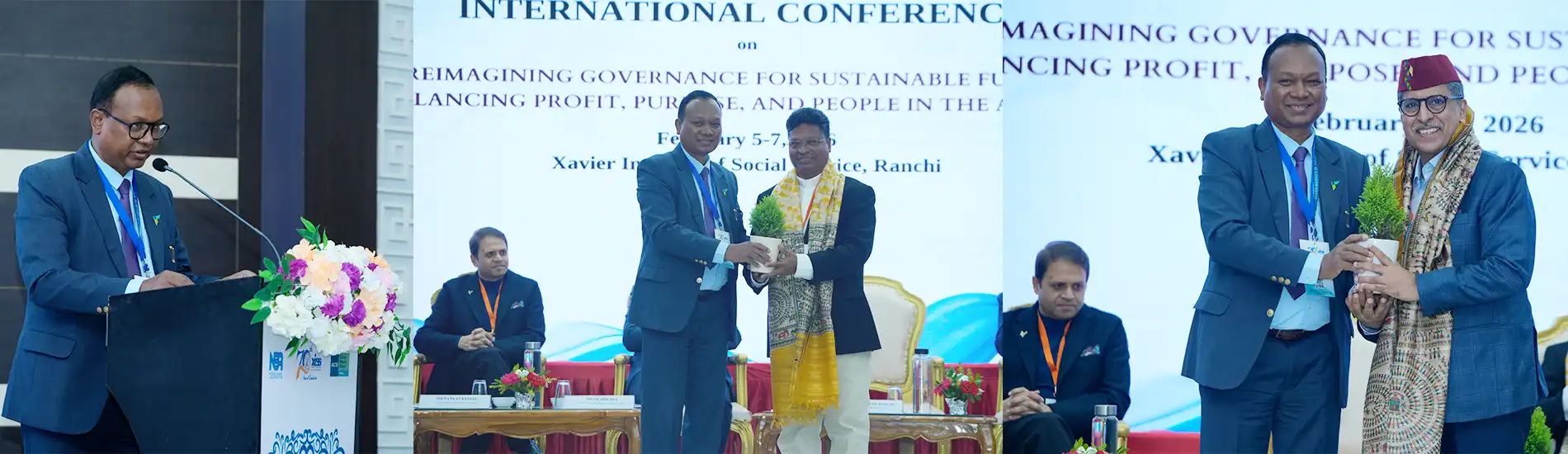
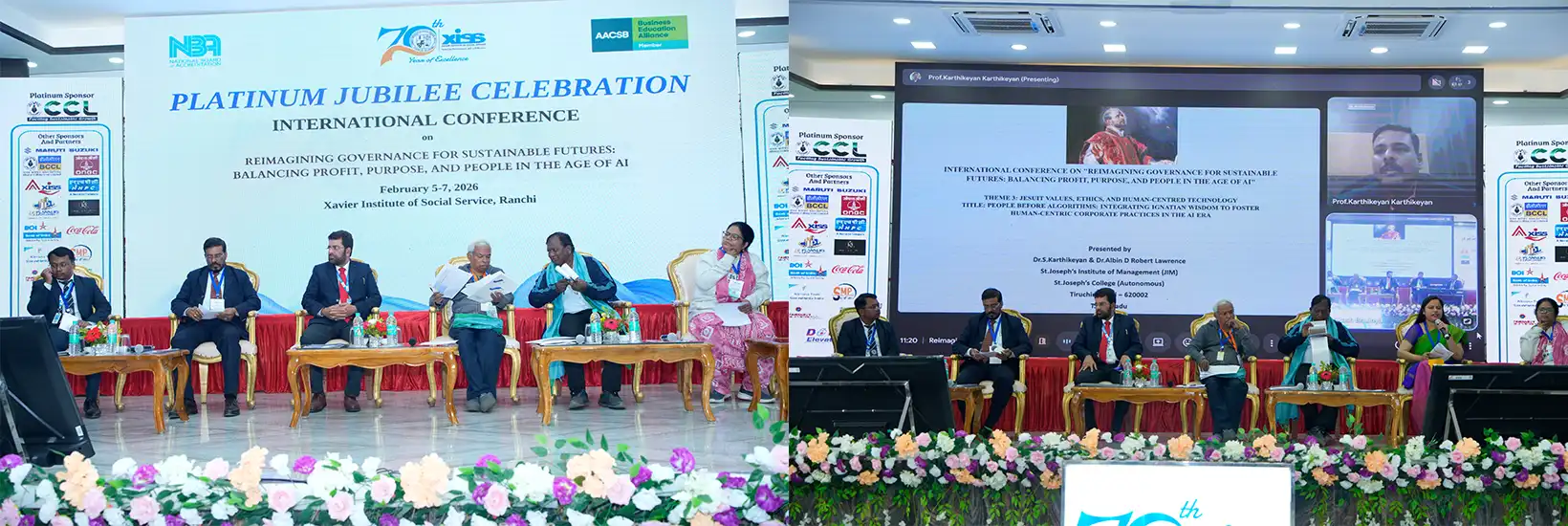
Xavier Institute of Social Service (XISS), Ranchi inaugurated its three-day International Conference on “Reimagining Governance for Sustainable Futures: Balancing Profit, Purpose, and People in the Age of AI”, in the campus from 5-7 February 2026. The conference was organised as part of the Platinum Jubilee celebration of the institute and brought together academicians, industry leaders, policymakers, and practitioners from India and abroad to deliberate on the intersections of technology, ethics, governance, and sustainable development.
The conference commenced with a focused aim on aligning technological progress with ethical values, emphasising people-centric and sustainable governance models. Inspired by the Jesuit tradition of social justice and human dignity, the conference promoted leadership approaches that balance profit, purpose, and societal well-being.
In his inaugural address, Dr Joseph Marianus Kujur, SJ, Director, XISS set the tone for the conference and said that this conference is a call to honour our past while courageously interrogating the future, ensuring that ethics, sustainability, and human values guide governance in the age of artificial intelligence. Efficiency often foreshadows empathy in AI-driven systems and profit, and purpose are complementary imperatives, not opposites, but our focus should be on ethical leadership, social justice, and responsible management education.
Fr Ajit Kumar Xess SJ, Chairman, XISS-GB congratulated the institute on its platinum jubilee celebration and discussed the topic saying that true governance must be human-centred, inclusive, and ethically grounded, where leadership decisions respect people, institutions, and the ecological systems we depend on.
Later, Chief Guest, Mr Prabir Jha, Founder and CEO, Prabir Jha People Advisory gave an enriching address to the audience and emphasized that we live in a BANI world — Brittle, Anxious, Non-linear, Incomprehensible. Governance is not compliance theatre, but the moral and strategic architecture of institutions. Growth without responsibility is hollow but real leadership lies in achieving results ethically, embracing discomfort, and ensuring that progress never comes at the cost of humanity.
Further in the session, Prof Joseph M Phillips, Dean Emeritus and Professor of Economics at Seattle University, USA discussed the topic and said that Artificial Intelligence is transforming economies and education, but without ethical reasoning and responsible governance, its growing concentration of power and impact on inequality is unsustainable.
Adding value to the event, Mr Pankaj Bansal, Co-Founder & Managing Partner, Caret Capital & Board Member of the Prime Minister’s Karm Yogi Bharat Initiative stated, Purpose is why we exist, vision is how you reach it, and values are what guide you. We must strategically link ancient wisdom with modern AI-era for leadership while keeping diversity, health, visibility, service, and higher purpose at the top. Our focus should be on personal mastery, meaning-driven work, and holistic growth.
Dr Vinay Ranjan, Director (HR), Coal India Ltd remarked that Leadership in a VUCA (Volatility, Uncertainty, Complexity, and Ambiguity) World demands adaptability, digital readiness, and the courage to learn through discomfort, because real impact is measured by outcomes, not effort alone. Competitors can copy technology, but not culture.
Prof Joaquin Garcia Tapial Arregui, Associate Dean, Loyola Leadership School, Spain highlighted the need for inclusive development models that integrate management innovation and technological empowerment to create sustainable and people-centric futures.
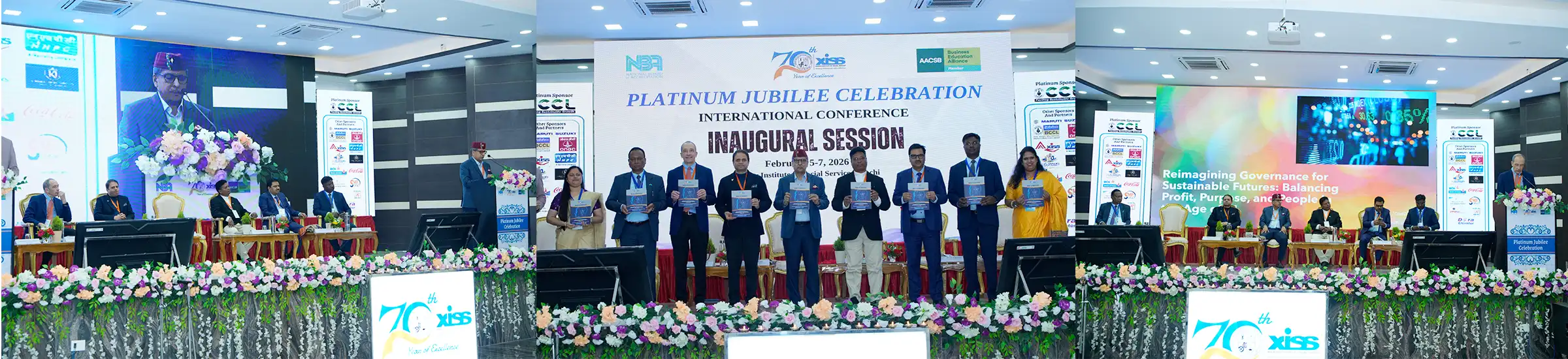
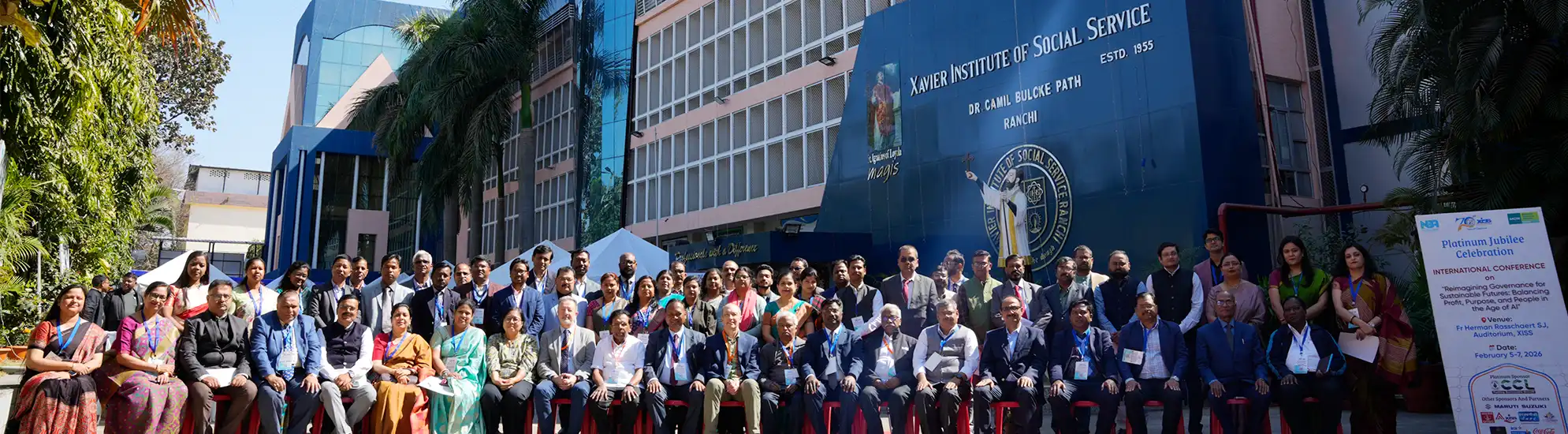
The programme also included the release of books and journals, felicitation of dignitaries by Director, XISS and a vote of thanks by Dr Amar E. Tigga, Dean Academics, who emphasized focus on deliverables and service to society. The session concluded with group photography marking a thoughtful beginning to the conference.
Later in the day, two plenary sessions were organised on topics namely Human Capital, Technology, and Organisational Transformation and Inclusive Development, Rural Management Futures, and Technological Empowerment, while 13 papers were presented on day one of the international conference.
Day 2
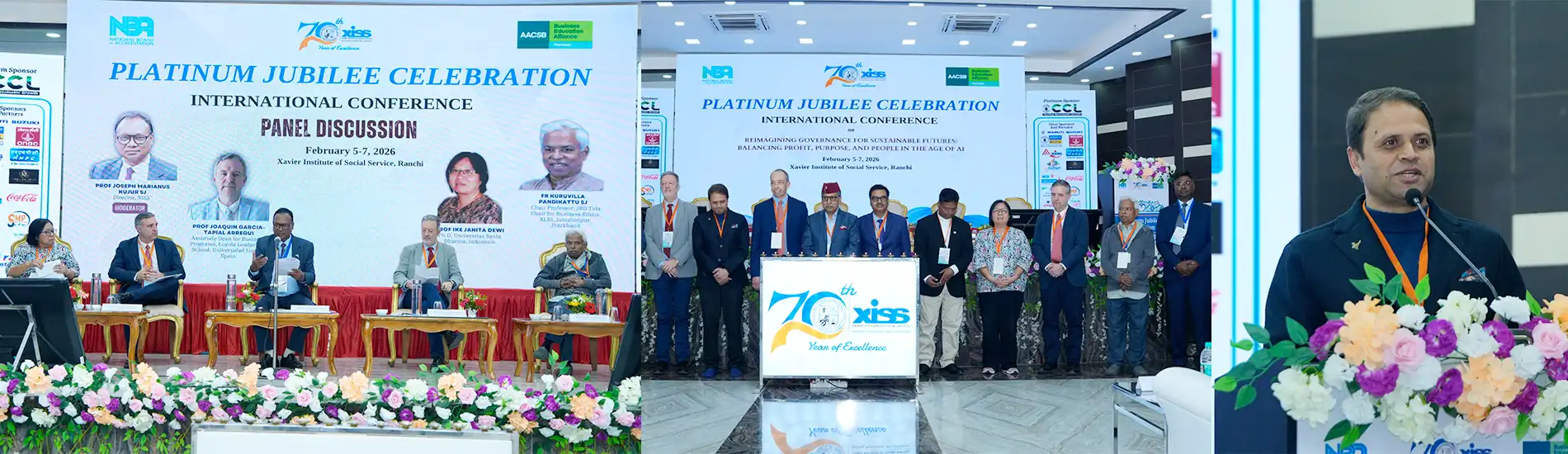
On the second day, first session was by Prof Kuruvilla Pandikattu SJ, Former Chair Professor, JRD Tata Chair for Business Ethics, XLRI Jamshedpur where he discussed about the Jesuit Values, Ethics, and Human-Centred Technology. This session examined AI and governance through a Jesuit ethical lens, arguing that technological risks stem from human choices, not machines. Prof Pandikattu discussed, “Is there anything fundamentally wrong with humans?” and then discussed personal moral responsibility. He elaborated on The Vatican’s AI framework on accountability, fairness, privacy, and transparency, with the reminder that “Ethics must shape technology from the beginning.”
Prof Ike Janita Dewi from Universitas Santa Dharma, Indonesia presented the second session on Marketing, Technology, and Innovation for Sustainable Growth and highlighted the gaps between sustainability awareness and actual consumer behaviour, as price, utility, and convenience often outweigh ethical considerations. She discussed embedding sustainability into brand identity, trust, and perceived value-supported by ethical sourcing and transparent practices-can drive adoption.
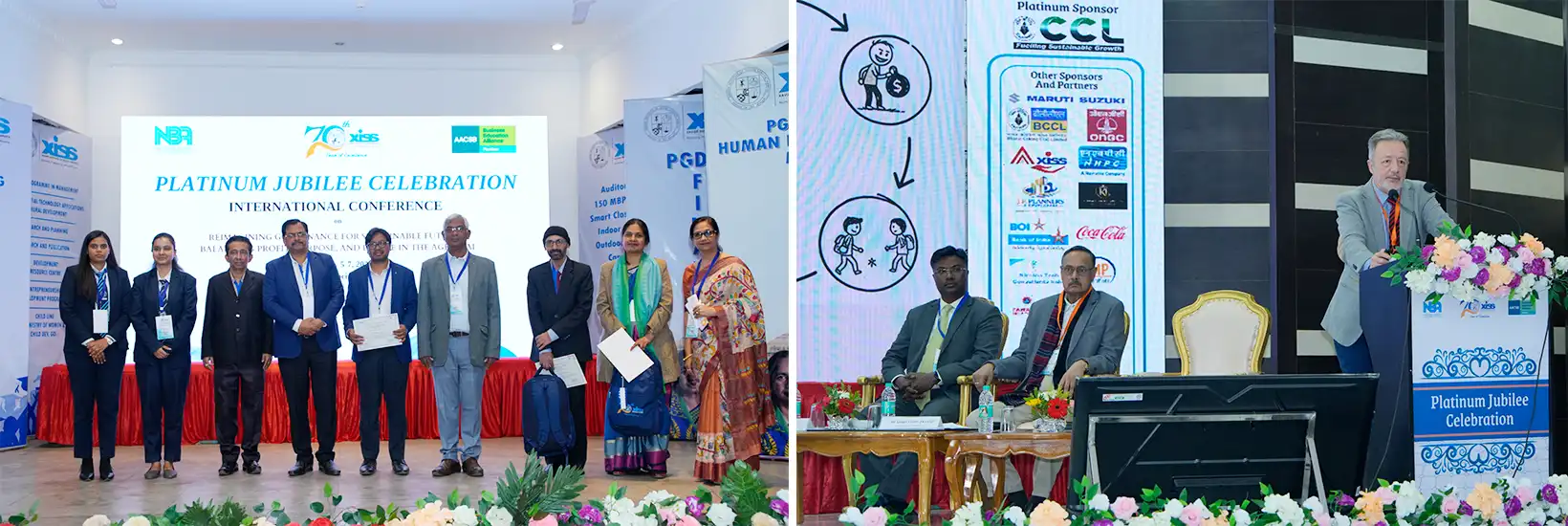
Mr Suresh Behra, Ex General Manager (System), CCL was the expert of the third session of the day on Finance, Governance, and Digital Transformation. His session stressed on Human Capital and Organisational Transformation reframe digital transformation as a strategic and purpose-driven journey rather than a technology-led quick fix. Emphasising the alignment of people, profit, and purpose, he described transformation as a gradual cultural and organisational shift, not merely automation. Drawing lessons from the banking and finance sector, the expert highlighted how technology enables efficiency only when supported by human capability and clear intent.
Concluding the day, an expert talk by Prof Javier García Rodríguez, CSR and International Trade Expert, Spain discussed Inclusive Rural Development and Ethical Markets. He focused on addressing rural poverty and market exclusion through ethical trade systems and social entrepreneurship rather than short-term fixes. Cooperatives and fair-trade models were proposed to reduce middlemen dependence, ensuring fair prices, transparency, and direct producer–consumer linkages. He concluded presenting Artificial Intelligence as an ethical market equaliser to enhance price transparency, forecasting, and decision-making, empowering small producers and fostering inclusive growth.
Concluding the day, an expert talk was conducted by Dr Amritanshu Prasad, CEO, Blackrock Mining on General Management and Entrepreneurship. He emphasized entrepreneurship, sustainability, and technology-driven growth as central to modern economic development. Innovation in unexplored areas, coupled with speed, resilience, and continuous effort, was identified as essential for meaningful progress, with AI already influencing productivity and behaviour. Jharkhand’s strong industrial base and growing GSDP were highlighted, alongside the need to move beyond raw resource extraction toward value-added processing and efficiency. Expanding MSMEs, fintech, and collaborative, data-driven ecosystems were seen as key growth engines. He concluded the talk by stating that purpose-driven innovation, green technologies, and youth leadership are critical for building an inclusive and sustainable future.
Later in the day, 15 papers were presented on several topics including Algorithmic Governance and Human Dignity: Reframing AI in Public Sector Decision-Making, Women in Geospatial Industry – empowered by mentoring and online communities, Unorganized Human Capital in Jharkhand: Dilemma in Ethical Governance and Decision-Making in Complex Digital Systems, Human-Centered Technology Rooted in Jesuit Values: An Ignatian Pedagogical Perspective, Balancing Personalization and Privacy: Ethical Marketing in the Age of the DPDP Act, 2023, Understanding Consumer Trust on Digital Payment Apps and Its Impact on Usage Among College Students, Digital Divide and Fintech Literacy: UPI Challenges Among Women Vendors in Ranchi, Jharkhand, The Invisible Price Tag: Unravelling the Economics and Behaviour Revealed by the Pink Tax and Gender-Based Marketing, and Entrepreneurship Economics of Women in India: A Comparative Analysis between Odisha and Jharkhand among other topics.
Day 3
The third day of the conference focused on the transformative potential of people-oriented development and the importance of trust, dignity, and collective responsibility in enabling sustainable social change. The proceedings emphasized that meaningful development emerges not merely from policies, funding, or technological interventions, but from strengthening communities and empowering individuals.
The valedictory session commenced with the address by Dr Joseph Marianus Kujur, SJ, Director, XISS, who warmly welcomed all and described the gathering as a moment of pride and reflection, noting that such occasions create lasting memories and strengthen the collective spirit of the institution. “We may not change the whole world at once, but we can certainly change the world of someone around us,” he concluded.
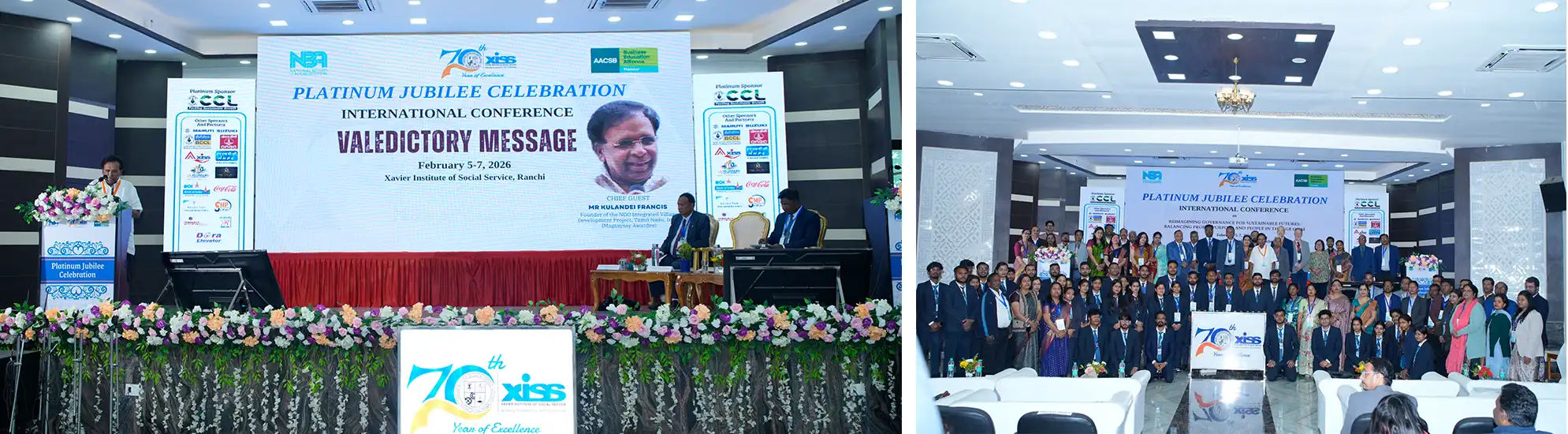
Chief Guest of the valedictory session, Mr Kulandai Francis, Founder-President, Integrated Village Development Project (IVDP) and Ramon Magsaysay Award Winner. Speaking as a practitioner rather than a scholar, he emphasized that genuine development must begin with people and their lived realities rather than with schemes, plans, or funding mechanisms. Development is not something we do for people; it is something we build with people, Mr Francis summarised.
The rapporteur summary was presented by Dr Amar Tigga, Dean Academics, who presented a concise synthesis of the key insights from the three-day deliberations and said that technology may accelerate change, but only people can give it direction and purpose.
An integrated institutional initiative was announced for 5–10 students of XISS who will receive sponsorship and academic support, reaffirming the institute’s commitment to inclusive and equitable education.
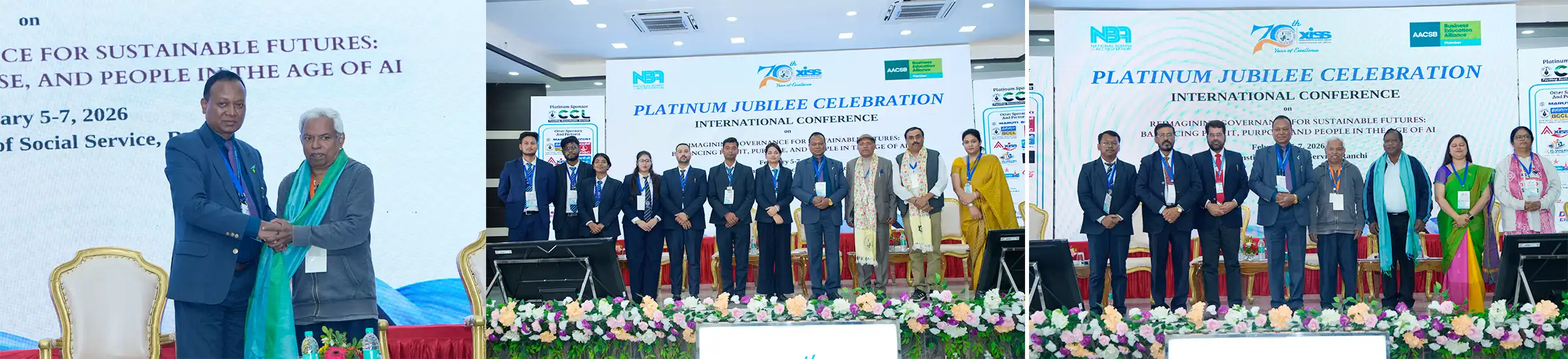
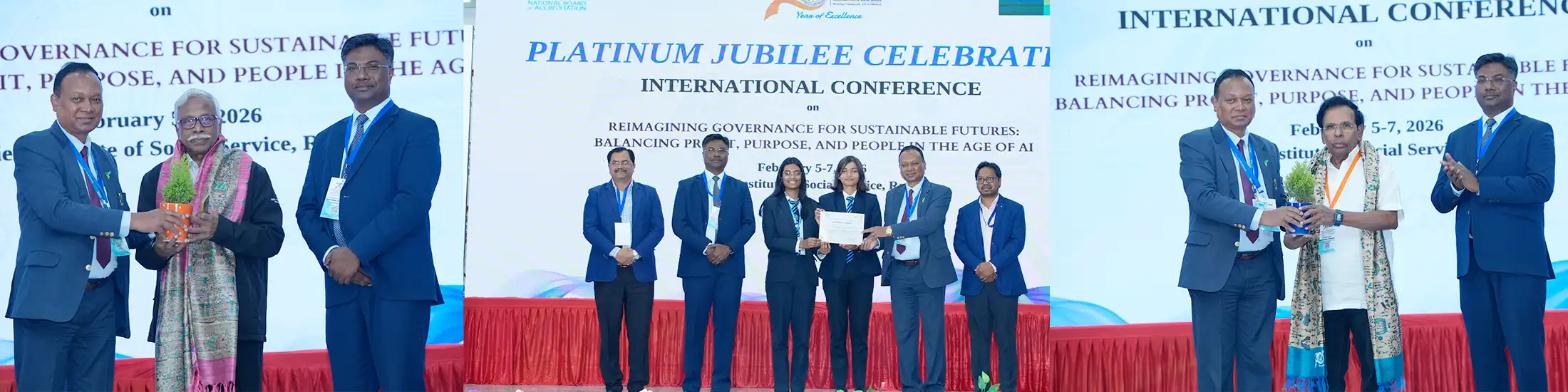
Awards and certificates were distributed among the presenters, scholars, and volunteers on the concluding day. The Best Paper and Track Awards were given to Rohit Kumar & Dr C Vanlazwana, Dr Uma Chatterjee Saha, Dr Shyamal Gomes, Kashish Bharadwaj & Dr Madhumita Singha, Ishita Singh & Trishala Vijay. The Best Poster Awards were given to Prerna Chaurasiya & Dr K Kusumawati, Niharika Gupta & Dr Sourya Das, and Manisha Kumari & Dr Shaurya Das.
Dr Sharda Singh delivered the vote of thanks and expressed gratitude to the Chief Guest, dignitaries, organizing committee, volunteers, and participants for their collective efforts in ensuring the success of the conference.